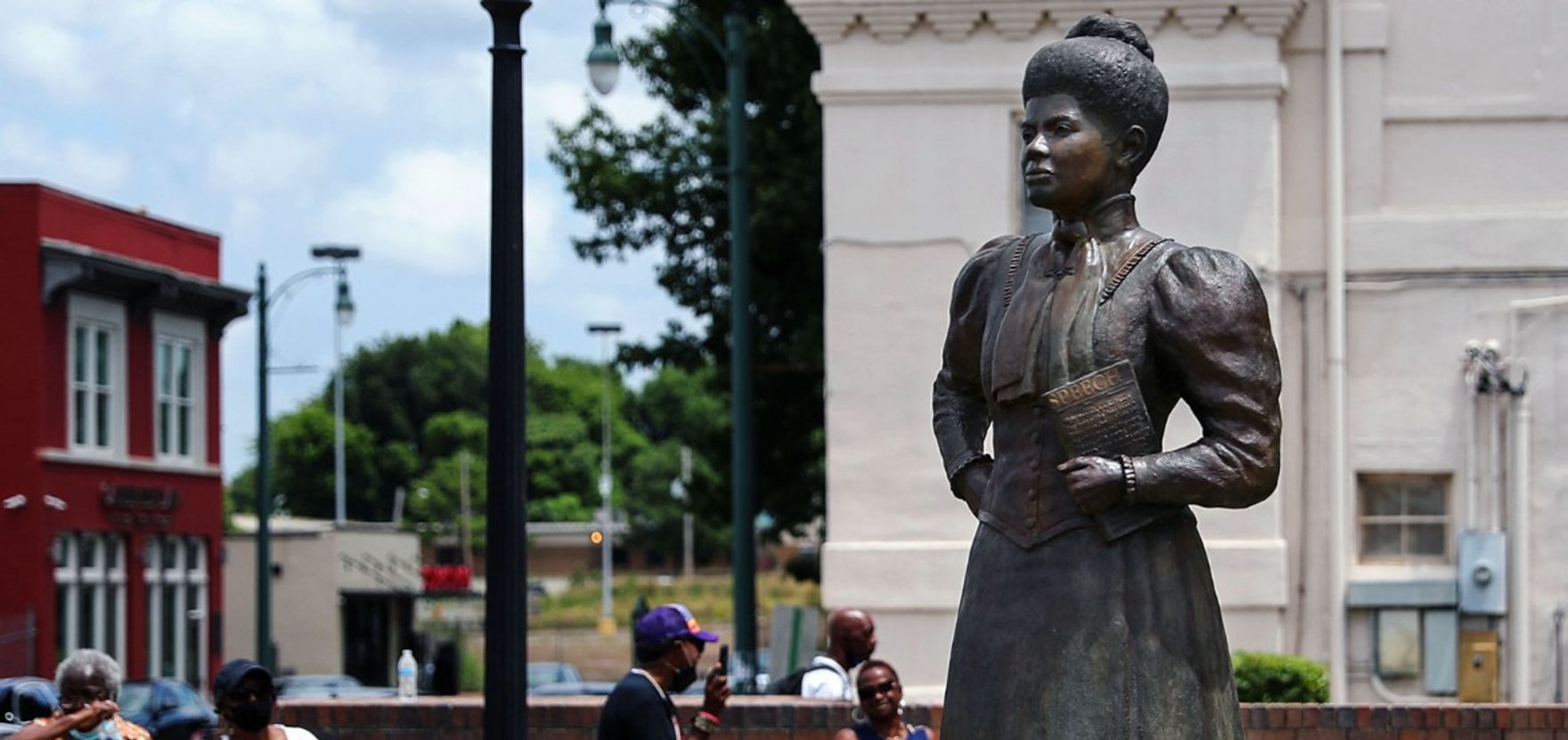
Ida Bell Wells was born enslaved in Holly Springs, Mississippi, on July 16, 1862, months before the Emancipation Proclamation would begin to loosen the chains she was born into. Freedom found her as a child. What she did with it changed a country.
Born into bondage, raised into resolve
When a yellow fever epidemic took both of her parents and her infant brother in 1878, sixteen-year-old Ida refused to let her surviving siblings be scattered. She lied about her age, took a job as a country schoolteacher, and kept her family together under one roof. The steel that would later terrify the powerful was forged early, in a house she held up alone.
The seat she would not give up
In 1884, decades before Rosa Parks, Wells bought a first-class train ticket and was ordered to move to the smoking car because she was Black. She refused. When the conductor tried to force her, she bit his hand and braced herself against the seat until three men dragged her off. Then she did what became her signature: she sued the railroad, and she wrote about it. She won at trial before the verdict was overturned on appeal, and a journalist was born.
The reporter who counted the dead
By the early 1890s Wells was co-owner of the Memphis Free Speech and Headlight. In 1892, three of her friends, including grocer Thomas Moss, were lynched by a white mob for the crime of running a store that competed with a white one. Grief could have silenced her. Instead it made her exact.
She traveled the South gathering names, dates, and eyewitness accounts, and she published the truth she found: that lynching was not a response to crime but a tool of terror and economic control. Her pamphlets, Southern Horrors in 1892 and The Red Record in 1895, were not opinion. They were evidence, assembled with a rigor that shamed a nation into looking. A mob destroyed her printing press and warned her never to return to Memphis. She kept writing anyway, from New York and then Chicago, carrying her campaign across the country and across the ocean.
The way to right wrongs is to turn the light of truth upon them. Ida B. Wells, The Red Record, 1895
A founder, a suffragist, a force
Wells helped build the institutions that outlived her. In 1909 she was among the founding members of the NAACP. In Chicago she founded the Alpha Suffrage Club, one of the first organizations for Black women's voting rights, and in the 1913 suffrage march on Washington she refused an order to walk at the back with the other Black women, stepping instead into the Illinois delegation where she belonged. She married attorney and publisher Ferdinand Barnett, became Ida B. Wells-Barnett, raised a family, and never stopped organizing, for anti-lynching law, for the vote, and for her neighbors on the South Side.
Her legacy, unfinished
Ida B. Wells died in Chicago on March 25, 1931. For much of the century that followed, her name was known to too few. In 2020 she was awarded a posthumous Pulitzer Prize special citation for her courageous reporting. The recognition was overdue. The work is not finished.
That is why we carry her name forward, not as a monument but as an assignment. Her methods, verify, document, and refuse to be silent, are the same tools a new generation needs. The film tells her story on screen. The movement puts her methods back to work.
Her story isn't over.
A film is bringing her life to the screen, and a movement is carrying her methods forward. Both need people willing to do the hardest work. Start here.
See the Film » Join the Movement »